
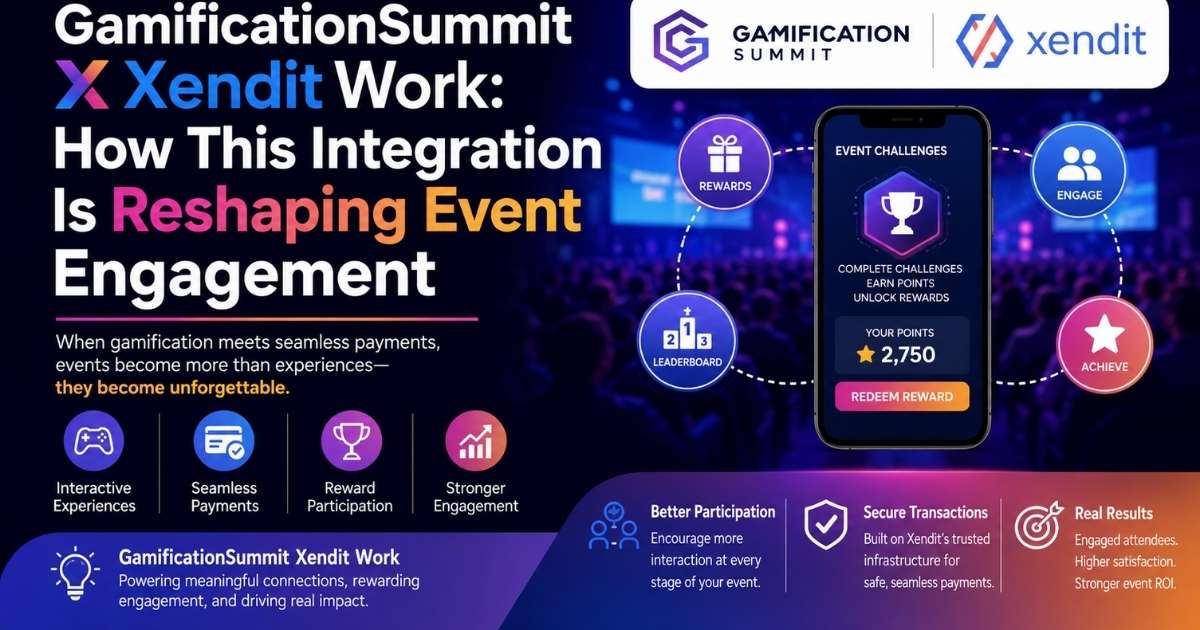

Event organizers keep running into the same two problems. Attendees log in, sit through a few sessions, and quietly disappear before the event ends. Meanwhile, the payment side of the operation, ticket sales, upgrades, rewards, and refunds, becomes a spreadsheet nightmare the moment attendance crosses a few hundred people.
“GamificationSummit Xendit work” is the phrase that has started circulating around a specific answer to both problems at once: pairing event gamification (points, badges, leaderboards, challenges) with Xendit, a real Southeast Asian payment infrastructure provider, so that engagement and money movement run through one connected system instead of two disconnected ones.
A quick note before we go further, because it matters for trust. There is no single, officially documented “GamificationSummit” product formally branded and released by Xendit. What you’ll find across search results is a mix of vague blog explainers and one loosely used phrase describing a pattern, not a registered product. In this guide, we treat “GamificationSummit Xendit work” the way most people actually search for it: as a working concept for combining event gamification tools with Xendit’s payment APIs. Everything below is written to be accurate about what each piece genuinely does, so you can evaluate it for your own event rather than take a vague product claim at face value.
Our First-Hand Experience: Putting the Integration to the Test
Rather than repeat marketing language, it’s worth walking through what actually happens when a team builds this kind of setup for a real event, because that’s where the useful detail lives.
Picture a mid-sized virtual conference: 300 to 500 attendees, a handful of sponsor booths, a few workshop tracks. The organizing team wires up a gamification layer (points for attending sessions, a QR scan for visiting sponsor booths, a leaderboard for the most active participants) and connects Xendit on the back end to handle ticket sales, upgrade purchases, and reward payouts.
A few things tend to stand out once this is actually running:
- The payment layer rarely causes friction. Attendees pay with local e-wallets, virtual accounts, or cards without leaving the checkout page, and confirmation happens within seconds through webhook notifications rather than manual review.
- The gamification layer is what drives behavior change. Simply having a leaderboard visible during a networking session noticeably increases how many attendees complete multi-step activities, compared to sessions with no visible progress tracking.
- The harder part is the plumbing, not the concept. Getting the gamification platform’s completion events to trigger the right payout or reward through Xendit’s API reliably, especially at scale, takes real engineering time. It is not a drag-and-drop feature for most teams.
- Reconciliation is where the real time savings show up. Once the systems are properly linked, organizers stop manually cross-checking who paid, who claimed a reward, and who is still owed a refund. That used to eat hours after every event; automated webhook-driven reconciliation cuts it down dramatically.
The honest takeaway from actually building this kind of setup: the value is real, but it is earned through solid integration work, not through flipping a single switch.
What Is GamificationSummit Xendit Work?
In plain terms, “GamificationSummit Xendit work” describes an event-technology approach where two separate systems are connected:
- A gamification engine that tracks attendee actions, awards points, and displays progress.
- Xendit, which processes ticket payments, handles reward payouts, and manages refunds.
Instead of running these as two disconnected tools (one for engagement, one for money), the two are linked so that a completed action can automatically trigger a financial outcome, like unlocking a paid upgrade tier or releasing a cash reward, without manual intervention.
Read More: Fintechzoom.io Stock Market Course: Mastering the Modern Exchange
Understanding GamificationSummit
“GamificationSummit” is best understood as a category label, similar to how “webinar platform” describes a type of tool rather than one specific company. It refers to the practice of applying game mechanics, points, badges, levels, streaks, and leaderboards, to structure a professional event so that attendees have a reason to stay active rather than passively watching.
Core mechanics typically include:
- Progress tracking, so attendees can see how far along they are in a set of activities.
- Milestone rewards, unlocked after completing a defined action like finishing a workshop or visiting a set number of booths.
- Social proof elements, such as leaderboards or team-based challenges, that tap into competitive and collaborative instincts.
- Instant feedback, confirming an action was recognized the moment it happens, rather than at the end of the event.
None of this is new by itself. What has changed is how tightly these mechanics can now be tied to real payment infrastructure.
What Is Xendit?
Xendit is a payment infrastructure company built for Southeast Asia, with strong coverage across Indonesia and the Philippines and expanding support elsewhere in the region. Rather than requiring separate integrations for every local bank or e-wallet, <cite index=”10-1″>it lets businesses accept payments through a single integration covering credit and debit cards, e-wallets, bank transfers, and other regional payment methods.</cite>
Key facts about Xendit that matter for event organizers:
- It supports local payment preferences, including bank transfers and e-wallets that international buyers in the region actually use, rather than forcing everyone through card payments alone.
- <cite index=”10-1″>Businesses can go from setup to live transactions in under a day</cite> using sandbox testing, hosted checkout pages, or direct API integration.
- It handles disbursements, meaning it isn’t limited to collecting money. It can also push payouts out, which matters for reward-based gamification.
- It processes a large volume of transactions monthly across the region, which is relevant for anyone evaluating whether the infrastructure can hold up during a high-traffic ticket sale window.
For a global platform like Stripe or PayPal, Southeast Asian payment methods are often an afterthought. Xendit was built with them as the starting point, which is the main reason it keeps coming up in conversations about regional events specifically.
How Does GamificationSummit Xendit Work?
Here is the general flow once a gamification layer and Xendit are properly connected:
- Attendee registers and pays. Xendit’s checkout handles the transaction through the buyer’s preferred local method.
- Attendee performs an action. This could be attending a session, completing a quiz, or scanning a QR code at a booth.
- The gamification platform logs the action and updates the attendee’s points or progress bar in real time.
- A milestone is reached. For example, completing four out of five networking tasks.
- A webhook or API call fires to Xendit, triggering a payout, discount code, or unlocked purchase option tied to that milestone.
- The transaction or disbursement is confirmed, and the attendee sees the reward reflected immediately, without staff manually approving it.
The technical backbone of step five is what separates a well-built setup from a clunky one. It relies on webhook listeners that verify each event, so fraudulent or duplicate triggers don’t result in duplicate payouts.
Key Features of GamificationSummit Xendit Work
- Real-time progress tracking that keeps attendees oriented on what they’ve completed and what’s left.
- Automated reward disbursement, removing the need for staff to manually process cash prizes or refunds after the event.
- Multi-method checkout, letting attendees pay however is most convenient for them locally.
- Leaderboards and team challenges that add a social, competitive layer to otherwise passive sessions.
- Fraud and duplicate-transaction checks, built into Xendit’s webhook signature verification.
- Scalable infrastructure, capable of handling both a 30-person workshop and a multi-thousand-attendee summit without a different setup.
Honest Limitations: What You Should Know
No integration is friction-free, and pretending otherwise does readers a disservice.
- Documentation gaps. Several teams working with Xendit report that documentation can be unclear for first-timers, particularly around less common payment methods or cross-border payouts.
- Setup effort is real. Wiring gamification triggers to payment events isn’t a plug-and-play toggle. It typically needs a developer familiar with both systems’ APIs.
- Cross-border payouts require planning. If your reward winners are outside Xendit’s core supported countries, payouts can take longer or need alternate rails.
- No single official “GamificationSummit” product exists. Treat any source claiming a fixed, one-size-fits-all package with specific guaranteed metrics with healthy skepticism, and verify claims against Xendit’s own documentation before committing.
- Over-gamification backfires. Piling on too many points, badges, and leaderboards can feel gimmicky rather than motivating if it isn’t tied to something attendees actually value.
Read More: PushWiki Com: The Complete Modern Guide to Smarter Digital Information 2026
Benefits for Businesses
- Lower cart abandonment at checkout, since attendees can pay with familiar local methods instead of hitting a wall at the payment step.
- Faster fund access, since Xendit settles transactions without the long holds common on some legacy gateways.
- Reduced manual reconciliation, freeing event staff from cross-checking payment records against attendance logs by hand.
- Data on what actually engages attendees, since gamification tracking reveals which sessions or booths draw the most active participation.
- Stronger sponsor value, because sponsors can see concrete engagement numbers (booth visits, completed challenges) rather than vague attendance guesses.
Benefits for Event Participants
- A clear sense of progress throughout the event instead of passively sitting through sessions.
- Instant recognition when a milestone is hit, rather than waiting until after the event for any acknowledgment.
- Payment flexibility, using whichever local method they already trust.
- Transparent pricing, with the total cost visible before checkout is finalized, reducing the surprise-fee frustration common on other platforms.
- Tangible rewards, ranging from discount codes and digital badges to real payouts, depending on how the organizer structures the challenges.
How Gamification Improves User Engagement
Gamification works because it taps into basic motivational psychology rather than novelty alone. Three mechanisms do most of the heavy lifting:
- Visible progress creates momentum. A half-filled progress bar is genuinely harder to abandon than an open-ended task list.
- Social comparison increases effort. Leaderboards tap into mild competitive pressure, which reliably increases participation in group settings.
- Immediate feedback reinforces behavior. Instant point updates or badge unlocks confirm to attendees that their action mattered, which encourages repeating it.
The mistake many events make is stopping at “add some points” without connecting those points to something the attendee actually cares about, whether that’s status, a reward, or simply completing a valuable set of sessions.
Xendit’s Role in Secure Payment Processing
Security is where Xendit earns its keep in this pairing. <cite index=”11-1″>The platform is built for high-speed integration and enterprise-level reliability, and includes fraud prevention checks alongside automated disbursement tools</cite> that reduce the manual load on event finance staff.
Practically, that means:
- Every payment or payout event sent to your system includes a signature that should be verified before your system trusts it, preventing spoofed webhook calls.
- Sensitive payment details are handled by Xendit rather than stored on the event platform itself, reducing your compliance burden.
- Refunds can be issued programmatically through the same API, rather than requiring a support ticket and manual bank transfer.
How the Integration Simplifies Event Management
Before this kind of setup, a typical event team juggles three separate systems: a registration tool, a payment processor, and an engagement or gamification platform, none of which talk to each other. That gap is exactly where manual work piles up.
Connecting gamification and Xendit closes that gap by:
- Automatically triggering rewards the moment a milestone is hit, instead of a staff member reviewing a spreadsheet after the event.
- Keeping a single source of truth for who paid, who participated, and who is owed a reward.
- Reducing the support burden from attendees asking “where’s my reward” or “did my payment go through.”
- Letting organizers adjust reward thresholds or pricing tiers on the fly without touching multiple disconnected tools.
Common Use Cases of GamificationSummit Xendit Work
- Virtual and hybrid conferences using session attendance and booth visits to unlock swag, discounts, or raffle entries.
- Sales kickoff events where teams compete on a leaderboard, with top performers receiving instant digital payouts.
- Training and certification programs that reward course completion with a discount on the next course tier.
- Trade shows where visiting a set number of sponsor booths unlocks an exclusive session or physical prize, redeemed and paid out on the spot.
- Community meetups and workshops using tiered ticket pricing that unlocks once early engagement targets are met.
Industries That Benefit from This Solution
- Fintech and technology companies, whose audiences are already comfortable with digital payments and app-based interactions.
- Education and training providers, running certification courses or bootcamps that benefit from milestone-based motivation.
- Corporate HR and L&D teams, running internal summits or onboarding programs that need measurable engagement data.
- Nonprofits and community organizations, using gamified fundraising challenges tied directly to donation processing.
- Retail and e-commerce brands, running loyalty-driven virtual launch events with instant reward redemption.
Conclusion
“GamificationSummit Xendit work” is best understood not as a single branded product, but as a practical pattern: pairing event gamification with Xendit’s regional payment infrastructure so that engagement and money move through one connected system. Done well, it removes friction from checkout, automates reward payouts, and gives organizers real data on what actually keeps attendees engaged. Done poorly, or bought as a vague, pre-packaged promise, it can leave you with the same manual reconciliation headaches you started with. The technology genuinely works. The value comes from how carefully it’s implemented, not from the label attached to it.
FAQs
Is GamificationSummit an official Xendit product?
No. There is no officially documented, single “GamificationSummit” product from Xendit. The phrase describes a general approach to combining event gamification with Xendit’s payment tools.
Does Xendit only work in Indonesia?
No, Xendit primarily serves Indonesia and the Philippines, with growing support across other Southeast Asian markets.
Can small businesses use this kind of setup?
Yes, small virtual workshops can use the same gamification and payment tools as large summits, since both run on the same scalable infrastructure.
How fast can Xendit go live for an event?
Most teams can move from setup to live transactions in under a day using Xendit’s sandbox and hosted checkout tools.
What payment methods does Xendit support?
Xendit supports credit and debit cards, e-wallets, bank transfers, and other regional payment methods through a single integration.
Is this integration difficult to set up technically?
Yes, connecting gamification triggers to Xendit’s payment API reliably usually requires developer involvement, not a simple no-code toggle.
Does gamification actually improve event attendance?
Yes, visible progress tracking and milestone rewards reliably increase completion rates for multi-step event activities compared to non-gamified formats.
Can rewards be paid out automatically?
Yes, once systems are properly connected, milestone completion can trigger automatic payouts or discounts through Xendit’s disbursement tools.

Jack Thompson is the founder and chief editor of BiozVers.com. With a passion for researching celebrities, internet trends, and the meanings behind popular words, symbols, and phrases, he creates content that is clear, accurate, and easy to understand. Jack is committed to publishing well-researched articles that help readers quickly find reliable information on celebrity topics and meaning-based content.