
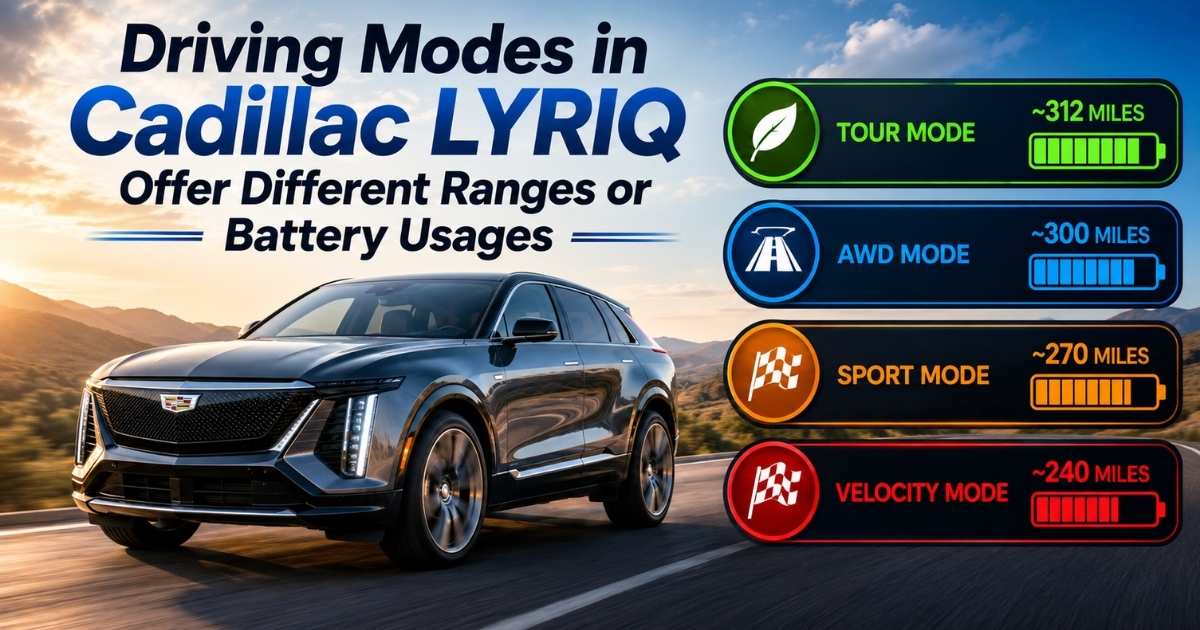

If you have ever sat behind the wheel of a Cadillac LYRIQ and looked at the drive mode selector, you have probably wondered whether tapping Sport instead of Tour actually costs you range. It is a fair question, and one that comes up constantly among new EV owners.
Do the driving modes in Cadillac LYRIQ offer different ranges or battery usages, or is the mode selector purely about how the SUV feels to drive? The short answer is this: driving modes do not change the LYRIQ’s battery capacity, but they absolutely change how efficiently that capacity gets used. Tour, Sport, Snow/Ice, and My Mode each adjust throttle response, regenerative braking, and traction management in different ways, and those adjustments show up as real differences in miles per kWh.
This guide breaks down exactly how each mode affects your range, what other factors matter just as much, and how to stretch every charge as far as possible, using real EPA figures, owner-reported efficiency numbers, and practical driving habits you can apply today.
Understanding the Cadillac LYRIQ’s Driving Modes
The LYRIQ is built on General Motors’ Ultium platform and comes with several selectable drive modes that reshape how the SUV responds to driver input. Each mode adjusts a mix of throttle mapping, steering weight, and regenerative braking calibration, and the change is felt instantly whether you are cruising with Super Cruise engaged or navigating city streets with Google built-in guiding the route.
These modes are separate from features like One-Pedal Driving and the Regen on Demand paddle, which control regenerative braking directly. Drive modes shape the overall personality of the SUV, while those regen features fine-tune how energy is recovered once you lift off the accelerator.
1. Tour Mode
Tour Mode is the default, everyday setting on most LYRIQ trims. It smooths out throttle response, softens acceleration, and calibrates regenerative braking for a relaxed, comfortable ride. Most owners leave the SUV in this mode for commuting and road trips because it favors predictability over quickness, and it is the mode Cadillac essentially designs around for daily livability.
2. Sport Mode
Sport Mode sharpens throttle response so the accelerator pedal delivers power more aggressively, and steering typically firms up as well. It is designed for spirited driving rather than efficiency, and that tradeoff is really the whole point of the mode. Some LYRIQ-V trims also offer a Velocity Max setting that pushes performance even further at the cost of additional range.
3. Snow/Ice Mode
Snow/Ice Mode softens power delivery to reduce wheel slip on low traction surfaces. Traction control intervenes earlier, and torque is metered out more gradually so the wheels do not spin on ice, snow, or wet pavement. This mode prioritizes stability over speed or efficiency, and it is worth selecting proactively before conditions turn slick rather than after.
4. My Mode
My Mode lets the driver customize individual settings such as throttle response, steering feel, and regenerative braking strength. Depending on how it is configured, My Mode can behave like a relaxed Tour setup or a sharpened, Sport style setup. It is essentially a blank canvas built around driver preference, which makes it the most flexible option for owners who want a personal balance between efficiency and responsiveness.
Read More: Understanding Goralblue com: Features, Benefits, and Content
How Driving Modes Impact Battery Usage and Range
The LYRIQ’s battery pack, rated at roughly 102 kWh of usable capacity, does not shrink or grow depending on which mode is selected. What changes is how quickly that fixed pool of energy gets consumed, since each mode alters throttle mapping, regenerative braking behavior, and how hard the traction control system has to work.
Tour Mode and Battery Efficiency
Tour Mode’s gentler throttle mapping means the motor rarely demands sudden bursts of power, which keeps energy draw low and steady. Regenerative braking is also tuned to recover energy smoothly during deceleration, making Tour Mode the most efficient everyday choice for stretching a charge.
Sport Mode and Battery Consumption
Sport Mode’s quicker throttle response encourages harder acceleration, and harder acceleration always pulls more current from the battery. Even a driver who does not intend to drive aggressively will likely see average consumption creep higher simply because the pedal calibration is sharper.
Snow/Ice Mode and Battery Usage
Snow/Ice Mode is not built for efficiency, it is built for control. Reduced torque delivery and a more conservative regenerative braking calibration, which helps prevent wheel slip during deceleration on slick surfaces, can mean slightly less energy recovery compared with Tour Mode.
My Mode and Battery Usage
Because My Mode is fully customizable, its effect on battery usage sits directly in the driver’s hands. A configuration tuned for smooth throttle response and strong regen behaves close to Tour Mode, while a configuration tuned for quick acceleration behaves closer to Sport Mode.
Quantifying the Impact on Range
Numbers help put this into perspective. The LYRIQ’s EPA-estimated range tops out at up to 326 miles for the single motor, rear wheel drive configuration and up to 319 miles for the dual motor, all wheel drive configuration, depending on trim and wheel size. Real-world testing by automotive publications has recorded results both above and below that figure depending on speed and conditions, which shows just how much variability exists before mode selection is even factored in. Mode selection then shifts real-world results further around that baseline.
Tour Mode
Because Tour Mode encourages the smoothest energy use, it tends to deliver results closest to the EPA rating. Many owners report meaningfully better efficiency in Tour compared with Sport, especially on mixed city and highway routes.
Sport Mode
Independent testing and owner reports commonly place Sport Mode’s range roughly 10 to 20 percent below Tour Mode, mainly because the sharper throttle mapping invites quicker acceleration and less disciplined regenerative braking use.
Snow/Ice Mode
The range penalty tied directly to Snow/Ice Mode is usually modest on its own, often just a few percentage points versus Tour Mode. However, the cold weather conditions that trigger the mode’s use tend to reduce range far more than the mode itself.
My Mode
My Mode’s range outcome mirrors whatever it is configured to do. An efficiency-focused setup can land close to Tour Mode’s numbers, while a performance-focused setup can approach or match Sport Mode’s higher consumption.
Practical Considerations
Choosing a driving mode is really about matching the setting to the situation rather than chasing one single “most efficient” answer. A few practical guidelines worth following:
- Use Tour Mode for daily commuting, highway cruising, and any trip where maximizing range matters more than quick acceleration.
- Switch to Sport Mode only when you actually want the sharper throttle response, such as merging onto a fast moving highway, then switch back afterward.
- Reserve Snow/Ice Mode for genuinely slippery conditions. It is a safety feature first and an efficiency setting second.
- Build a My Mode profile tuned for efficiency if you want a bit of Sport-like feel without the full battery penalty, or a performance profile for weekend drives.
- Pair whichever mode you choose with One-Pedal Driving and the Regen on Demand paddle to capture extra energy during deceleration.
None of these choices will double or halve your range on their own, but stacked together over weeks of driving, they add up to a noticeably different charging schedule. Think of drive mode selection as one lever among several, rather than the single dial that controls everything about your LYRIQ’s efficiency.
Read More: GamificationSummit Xendit Work: How This Integration Is Reshaping Event Engagement
Additional Factors Affecting Range and Battery Usage in the LYRIQ
Driving mode is only one piece of the range equation. Several other variables often move the needle more than the mode selector does, and understanding them gives a fuller picture of what actually determines how far a LYRIQ travels on a charge.
1. Driving Style: The Hidden Influence on Efficiency
Two drivers in the same LYRIQ, using the same mode, can see very different results. Frequent hard acceleration, late braking, and constant speed changes burn more energy than smooth, anticipatory driving, regardless of which mode is selected. In many cases, driving style has a bigger effect on efficiency than the mode itself.
2. Speed and Highway Driving
Aerodynamic drag increases sharply at higher speeds, so sustained highway cruising above 70 mph reduces range more than city driving in nearly every EV, the LYRIQ included. Independent highway range testing has shown real-world results noticeably below the EPA estimate for this exact reason, since EPA cycles include a mix of speeds rather than sustained high-speed cruising alone.
3. Environmental Conditions and Temperature
Cold weather is one of the biggest range killers in any electric vehicle. Battery chemistry becomes less efficient at low temperatures, and cabin heating draws additional power directly from the battery. Headwinds, rain, and rough pavement add further resistance on top of that, and combined winter conditions can reduce usable range more than any single drive mode ever would.
4. Terrain and Elevation Changes
Climbing steep grades demands more power and drains the battery faster, while descending can partially replenish it through regenerative braking. Mountainous routes typically show more range variability than flat terrain, independent of which drive mode is active at the time, so a scenic mountain drive and a flat interstate trip can produce very different efficiency numbers even at the same average speed.
Optimizing Battery Usage for Long-Term Health
Getting the most from a LYRIQ is not only about single trip range, it is also about protecting the battery’s long-term capacity through smart daily habits.
1. Charging Habits
Charging to around 80 percent for daily use, rather than routinely charging to 100 percent, helps preserve battery longevity while still covering most commutes. The LYRIQ supports Level 2 AC home charging and DC fast charging through its CCS1 port, with a NACS adapter available for access to Tesla Supercharger stations. Saving 100 percent charges for longer trips, rather than daily habit, reduces stress on the cells over the vehicle’s lifespan.
2. Battery Preconditioning
Before a DC fast charging session, the LYRIQ can precondition the battery to an optimal temperature through its Fast Charge Prep feature, which shortens charging time. Preheating the cabin while the vehicle is still plugged in also saves battery energy that would otherwise go toward climate control once you unplug, which is especially useful on cold mornings before a commute.
3. Regular Maintenance
Underinflated tires increase rolling resistance and quietly reduce range, so checking tire pressure regularly matters more than most owners expect. Choosing smaller wheel sizes where available, keeping vehicle software up to date, and scheduling routine service checks all help the LYRIQ maintain consistent efficiency over time, and catching small issues early prevents them from becoming bigger drains on both performance and range.
Conclusion
So, do the driving modes in Cadillac LYRIQ offer different ranges or battery usages? Yes, but with an important distinction: the modes reshape how efficiently the fixed battery pack gets used rather than changing its actual size. Tour Mode remains the most range-friendly everyday setting, Sport Mode trades efficiency for responsiveness, Snow/Ice Mode prioritizes safety over range, and My Mode lets drivers land anywhere on that spectrum depending on how it is tuned.
Mode selection matters, but it works alongside driving style, speed, weather, terrain, and charging habits to determine real-world results. Understanding how these pieces fit together, and applying a few simple habits like smoother acceleration, smart preconditioning, and moderate charging levels, helps every LYRIQ owner get closer to the SUV’s full potential on a single charge.
FAQs
Do Cadillac LYRIQ driving modes change the battery’s capacity?
No. Driving modes adjust throttle response, regenerative braking, and traction control. The battery’s usable capacity, about 102 kWh, stays the same in every mode.
Which LYRIQ driving mode gives the best range?
Tour Mode typically delivers the best real-world range thanks to its smooth throttle mapping and efficient regenerative braking calibration.
How much range does Sport Mode cost compared with Tour Mode?
Owner reports and independent testing commonly show Sport Mode using roughly 10 to 20 percent more energy than Tour Mode over the same distance.
Does Snow/Ice Mode hurt battery range?
Only slightly on its own. Most of the range loss associated with winter driving comes from cold temperatures and cabin heating, not the mode itself.
Can My Mode be set up to save battery?
Yes. Configuring My Mode with gentle throttle response and strong regenerative braking can make it perform close to Tour Mode’s efficiency.
Does wheel size affect LYRIQ range?
Yes. Smaller 19 or 20 inch wheels reduce rolling resistance and typically deliver better range than the larger 22 inch wheel option.

Jack Thompson is the founder and chief editor of BiozVers.com. With a passion for researching celebrities, internet trends, and the meanings behind popular words, symbols, and phrases, he creates content that is clear, accurate, and easy to understand. Jack is committed to publishing well-researched articles that help readers quickly find reliable information on celebrity topics and meaning-based content.